

Is Igbo Hard to Learn? My Honest Experience As a Polish Woman Learning Igbo
If you’ve ever heard someone speaking the Igbo language for the first time, you probably noticed how melodic and expressive it sounds. As a Polish woman learning Igbo and documenting my progress online, one of the questions I get asked constantly is:
“Is Igbo hard to learn?”
The short answer? Yes.
Longer answer? Maybe, it depends.
Like any language, Igbo has parts that feel easy and parts that completely confuse you at first. But after spending time learning and getting a bit of the language flow, I’ve realised something important:
Igbo is not impossible to learn, it’s just different. Its peculiarity is what makes it beautiful. I say this from the perspective of someone who already speaks five languages. If you are curios about the first 10 Igbo words I learnt, I shared them in an earlier post.
What Makes Igbo Difficult?
1. Tones Change Everything
Igbo is a tonal language, and that is one of the biggest challenges for learners who don’t know any other tonal language. The high (/), low (\), and mid/downstep (-) tones play a very important role in determining the meaning of words. One of the biggest challenges is recognising tonal differences. You can practise this using my Igbo Tone Practice Tool, which I designed specifically for learners.
The way you pronounce a word can completely change its meaning. Two words may be spelled similarly but mean entirely different things depending on the tone used. Here is a classic example using the word “akwa”:
• ákwà [high tone — low tone] = cloth
• ákwá [high tone — high tone] = cry
• àkwá [low tone — high tone] = egg
• àkwà [low tone — low tone] = bed
For English or Polish native speakers, this can feel strange because we are not used to relying heavily on pitch to communicate meaning. I personally struggled with Igbo tones at the beginning, but over time my ears gradually started adjusting.
My recommendation would be to expose yourself to the rhythm and sounds of the language as much as possible. Do not worry too much about understanding every word immediately. You are training your ears to recognise the sound patterns and rhythm of the language, and that is extremely important.
2. Some Sounds Don’t Exist in European Languages
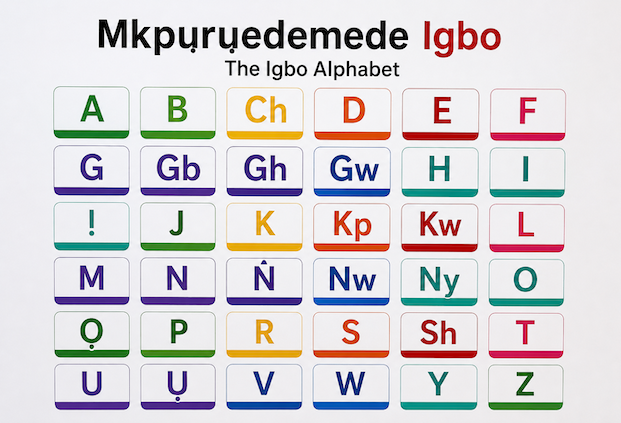
Igbo contains sounds and combinations that many English and Polish speakers have never used before. Digraphs like “gw”, “kp”, “nw”, “gb” can initially feel impossible to pronounce naturally. At first, your mouth feels unfamiliar with the movement required to produce those sounds correctly.
| Digraph | Pronunciation |
|---|---|
| “gw” | “gw” 🔊 |
| “kp” | “kp” 🔊 |
| “nw” | “nw” 🔊 |
| “gb” | “gb” 🔊 |
However, pronunciation improves significantly with listening, repetition and regular exposure to native speakers.
3. Limited Learning Materials
Another challenge is the limited availability of structured Igbo learning materials compared to globally dominant languages like French, Spanish or Mandarin.
While there are now more online creators, YouTube videos and language communities helping learners, it can still be difficult to find comprehensive textbooks, advanced courses or apps dedicated fully to Igbo learning.
Sometimes, I have had to rely heavily on conversations with native speakers, music and social media content to continue improving.
So… What Makes Igbo Easier Than People Think?
1. Some Areas of Igbo Grammar Are Surprisingly Straightforward
This part genuinely surprised me. Compared to many European languages, Igbo grammar can actually feel less stressful in some ways.
Inflection is limited. There are no endless verb conjugation tables like in French or Spanish. You also do not need to worry about grammatical gender or declension the way you would in languages like German or Polish.

Once you begin to understand sentence structure and patterns, building simple conversations becomes much easier.
However, Igbo grammar becomes more nuanced and complex at a more advanced level. Grammar is affected by the change of tonal patterns in a sentence, as a tone can mark a verb aspect or change an affirmation into negation. Vowels go through some processes which affect pronunciation and mastering that is quite challenging. But still, the good news is that Igbo grammar is clearly patterned and there are more rules than exceptions.
2. Igbo Is Very Expressive and Fun
One thing I love about Igbo is how alive the language feels. Even everyday conversations and expressions can sound dramatic, playful, poetic or emotional. I once made a video featuring a few lines I learned from Igbo Nollywood movies and people loved how expressive the phrases sounded.
Igbo proverbs and idioms often carry far more personality than direct English translations. As someone who does not enjoy memorising isolated vocabulary lists, I find proverbs and expressions the most enjoyable part of learning the language because every new phrase feels connected to real life and culture.
3. Most Native Speakers Encourage Learners
This has been one of the best parts of my journey. The encouragement from native speakers has helped me tremendously. Of course, there are occasional pockets of language shaming online, but I suppose that exists in almost every language learning space.
Overall, I have received overwhelming support across my social media platforms. My page has attracted intellectuals, Igbo language teachers, academics and Igbo language enthusiast from all around the world.
I believe many Igbo speakers genuinely appreciate the effort by learners because relatively few people outside Nigeria attempt to learn the language.
My Personal Experience Learning Igbo
When I first started learning Igbo, I constantly mixed up tones and pronounced words incorrectly. Sometimes I memorised phrases without fully understanding them. However, the more I listened to conversations, watched Nigerian content, practised with my husband and used the language daily, the more natural it became. I have a background in linguistics so curiosity also drives me. If you want to read the story of how I first started learning Igbo, I shared it in a previous post.
I still make mistakes today, but now I genuinely enjoy the learning process instead of feeling intimidated by it.
Final Answer: Is Igbo Hard to Learn?
Igbo can be challenging at first, especially if you grew up speaking non-tonal European languages. There are also other factors that define how challenging a target language can be, ranging from your native language, motivation, learning environment, consistency, access to native speakers, exposure to the language and even your previous language learning experience. Someone who already speaks multiple languages may adapt faster to unfamiliar sounds and structures than someone learning a second language for the first time.
However, difficult does not mean impossible. If you are consistent, willing to make mistakes, and open to understanding the culture behind the language, Igbo becomes much easier and more enjoyable over time.
Fluency begins with imperfect speech. Take your time and practise as much as you can. Your pronunciation may not sound great at first, but it gets better with repetition. Remember, there’s no need to be overly critical of yourself. Enjoy the journey.
You can even go through my Instagram and TikTok pages to see how I have gradually adopted the language throughout my journey. Let’s connect!
If you are new here, you can start with my first Igbo learning story. It explains how everything began.




Wow, this is truly inspiring! Seeing an European woman embrace Igbo language and culture like this is amazing. It shows that language has no boundaries when there is passion and respect. You didn’t just learn the words, you connected with the people and the culture, and that’s beautiful. Keep shining and inspiring others ❤️👏. I really wish to learn other languages aside from my Igbo language and Nigerian English. Ka Chineke nye gị amamihe, iji mụtakwuo ihe nke ukwuu
That’s cook jisike
Thank you! Daalụ rinne