
The Igbo Alphabet: The Foundation of Reading and Pronunciation
Once you start learning Igbo, one of the first things you will come across is abịdịị Igbo — the Igbo alphabet. And, if I’m being honest, it’s tempting to skim through and jump straight into words and grammar. After all, most of us already know how to read. That was more or less how I felt when I started learning Igbo.
But knowing the Igbo alphabet is not about learning which letters come after which, or how many letters there are in total. It is about understanding the sounds those letters represent, which form the foundation for reading, pronunciation, spelling and ultimately, understanding the language.
The Igbo Alphabet: A Map of Sounds
The Igbo alphabet contains 36 letters: 8 vowels and 28 consonants, including digraphs (pairs of letters that represent a single sound). It is based on the Ọnwụ orthography, the standard writing system introduced in 1961.
The writing system was designed to represent the sounds of the language as clearly and consistently as possible. Learning the alphabet gives you the building blocks of pronunciation, while learning tones (another aspect of the Igbo language) teaches you how those sounds come together to form meaningful words. Check out my free Igbo tone practice tool
So rather than thinking of the Igbo alphabet as a list of letters to memorise, think of it as a map of the sounds that make up the language. The more familiar you become with these sounds, the easier it becomes to pronounce new words and potentially, develop an ear for the language.
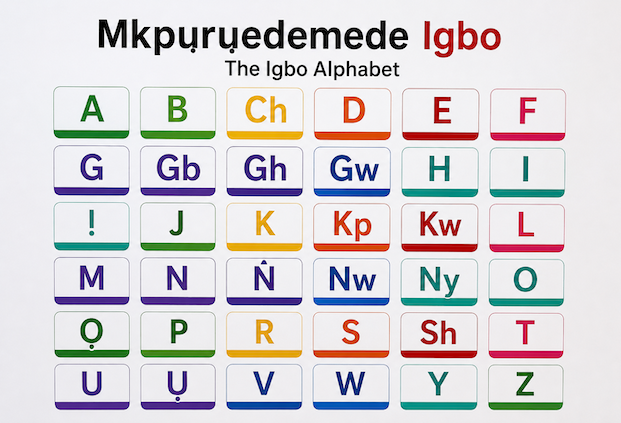
Getting to Know the Vowels (Ụdaume)
The Igbo alphabet has eight vowels: a, e, i, ị, o, ọ, u and ụ. Three of these letters — ị, ọ and ụ — are written with a dot below them. The dot is not simply a spelling feature; it indicates a different vowel sound. For example, o and ọ represent two distinct vowels rather than two versions of the same letter:
| Igbo | English | Sound |
|---|---|---|
| ogbo | “sponge” | |
| ọgbọ | “peer” |
This means that confusing a dotted vowel with a non-dotted vowel can change the meaning of a word as seen in the example above. Learning to recognise and pronounce each vowel accurately is therefore essential. The table below introduces Igbo vowels and how each of them is pronounced.
| A a | E e | I i | Ị ị | O o | Ọ ọ | U u | Ụ ụ |
|---|---|---|---|---|---|---|---|
The Consonants (Mgbochiume)
Many of the consonants used in Igbo will already feel familiar to learners, including b, d, f, g, h, j, k, l, m, n, p, r, s, t, v, w, y, and z. Igbo also includes sounds that may be unfamiliar to some learners. One example is ṅ, which represents a nasal consonant articulated toward the back of the mouth.
However, it is important to note that the latin letters c, q, and x are not part of the standard writing system because they are not needed to represent the sounds of the language.
The table below introduces consonants and how each is pronounced.
| b | d | f | g | h | j | k | l | m |
|---|---|---|---|---|---|---|---|---|
| ṅ | p | r | s | t | v | w | y | z |
|---|---|---|---|---|---|---|---|---|
The Digraphs (Ụda mkpi)
Not every letter in the Igbo alphabet is written with a single character. Some are digraphs —combinations of two letters that function as a single letter and represent one speech sound.
Although digraphs look like ordinary letter pairs, they are treated as individual units within the alphabet. Many native speakers provided insights on this in one of my reels online:

The table below introduces the Igbo digraphs and how each one is pronounced:
| ch | gb | gh | gw | kp | kw | nw | ny | sh |
|---|---|---|---|---|---|---|---|---|
How to Learn the Igbo Alphabet Effectively
If you are just starting out, there is no need to simply memorise the alphabet as a list and stop there. Instead, learn it through examples.
Learn the vowels: a, e, i, ị, o, ọ, u, ụ
Spend time listening to and producing the different sounds. Remember that ị, ọ and ụ are distinct vowels contrasting with i, o, and u. Getting comfortable with these differences will make reading and pronunciation easier as you progress. It took me a very long time to start hearing the difference between them and even longer to be able to pronounce them distinctively.
Learn the consonant combinations
Practise: ch, gb, gh, gw, kp, kw, sh. Say words containing them aloud and listen carefully to native speakers.
Start noticing tones
Once you are comfortable with the sounds, begin paying attention to pitch. I played around with tonal tongue twisters in Igbo when I started learning. I still do that to this day.
Read aloud
This is one of the simplest ways to connect spelling with pronunciation. Take short Igbo phrases and read them out loud slowly. Record yourself while pronouncing them, listen to native speakers and compare their pronunciation with your own.
A Few Parting Words
When I started learning Igbo, I often looked for explanations of its sounds. Many resources described them by comparing them with sounds in English. As a Polish speaker, I found these comparisons less helpful than intended. They often relied on native-speaker intuitions about English pronunciation: intuitions that even fluent second-language speakers may not share.
I think Igbo is distinct in its own way. Comparisons can be useful as a starting point, but they are not the ultimate. The goal is not to find the closest sound in a language you already know. The goal is to learn how Igbo itself organises the rich possibilities of human speech.
“Abịdịị Igbo” (the Igbo alphabet) is the first step in that process. It trains you to notice the sound distinctions that matter and gradually helps you hear the language on its own terms.